
By: Madison Mabry
SPRINGFIELD, Mo.— Dating back to the 1940s, the gardens at Phelps Grove Park used to be the kind of place where people stopped to smell the roses—literally. Over the years, though, time took its toll. Bricks cracked, weeds took over and the rose beds that once attracted weddings and weekend strolls became overrun with Bermuda grass. Citizens of the Phelps Grove Neighborhood Association remembered what it used to be, and in the beginning of 2024, they decided it was time to bring it back to life.
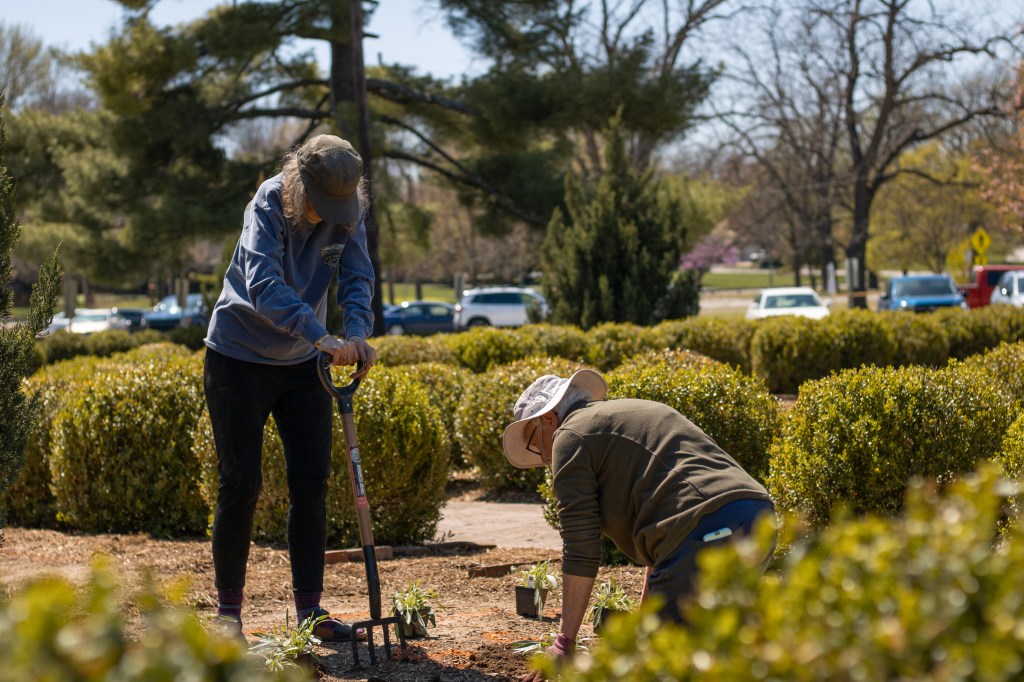
The revitalization process started quietly with just a few neighbors sharing a vision. Vicky Trippe, who has lived in the neighborhood for decades, remembers watching the garden fall into disrepair and thinking, “We need to make these beautiful again.”
With that spark, conversations turned into action. A $1,000 grant from the Community Foundation of the Ozarks and later a $3,000 grant from the Hatch Foundation became the seed money for something much bigger. Soon, a small but committed crew began showing up week after week to reclaim the space, and they have not stopped since.
Although the idea to renovate began based on the appearance of the gardens, the motivation goes far beyond aesthetics. “The birds and the butterflies and the insects are dying, and we wanted this to be a space that we could use the sun to provide a place to try to keep those pollinators,” Trippe said.
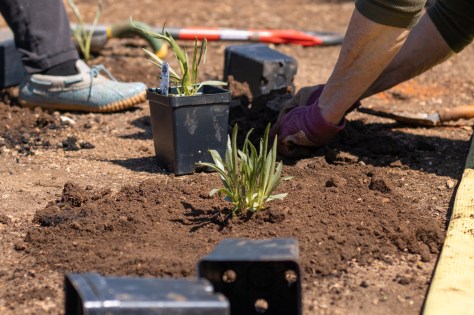
Across the country, studies have shown pollinators like bees and butterflies are disappearing at alarming rates. One study from the USDA found that bee abundance dropped by over 62 percent over 15 years in the United States. Another study by the American Association for the Advancement of Science reported a 22 percent drop in butterfly populations nationwide between 2000 and 2020.
The Phelps Grove garden restoration has a goal of improving these statistics and providing a place for pollinators to survive.
“Most of our yards have too many trees to grow the plants that need six hours of sun a day, or host plants and food plants for the pollinators,” Trippe said. The gardens, on the other hand, are full of sunshine. Trippe and her team are planting milkweed for monarch caterpillars, parsley for swallowtails and a variety of blooms that will keep pollinators fed from early spring to late fall. “Last year we had Monarch caterpillars over here on the milkweed, and there will be more,” Trippe said.
The restoration is a patchwork of community effort. The Missouri State University Horticulture Club provided plants and support for two of the raised beds. Neighbors have donated benches, trellises, flowers and several other items. One neighbor offered his landscaping equipment to haul out rocks and stumps when he saw the team struggling. Fran Giglio, who lives across from the gardens, gifted a pavillion, an irrigation system, a wheel chair accessible sidewalk, benches, and has made several other contributions while also volunteering in the garden. “[The garden] is proof that it does take a village,” Trippe said.
The Springfield-Greene County Park Board partnered with the neighborhood team to help with the renovations. “The parks department, we lean on them for bringing supplies like mulch or playing ideas off of them for what we want to do,” Connie Ryan, a volunteer in the garden who became a parks department employee after the garden renovation work began, said. “They play an important role in helping move things forward.”
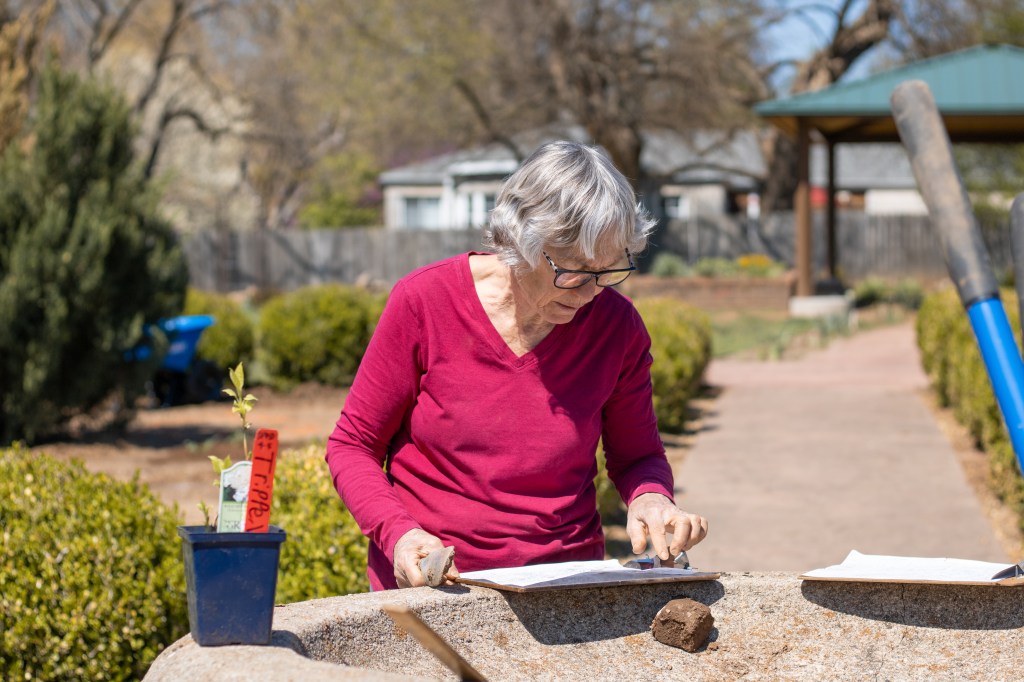
After about a year of renovating, a core group of five people continue to lead the effort, showing up between work schedules and weather changes. One of these individuals, Andy Massoth, is not from the Phelps Grove neighborhood, but was visiting the park when he heard about the renovation. “I saw these ladies working over here last April, and decided to go up and see if they wanted some help,” Massoth said. “I think it’s a really great thing they’re doing, because the members of the community and neighbors that stop by, they’re very appreciative of it, and they always thank us for it.”
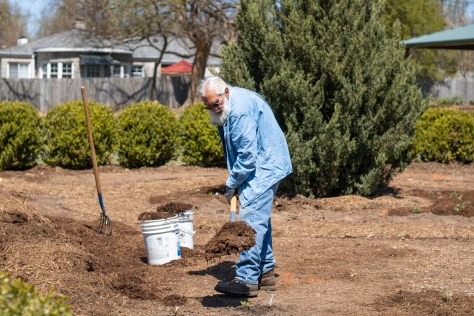
The group spent much of the winter trimming bushes, laying pathways, restoring brickwork and doing what they could to prepare for the planting they are doing now.
Trippe said the group started out thinking they could manage to restore three beds. They have already done eleven and they are not finished yet.
The impact of the restoration has been easy to see for the volunteers. “Since we started this project, just the little things that we did, we have started seeing people come from the west side, in the more tree part of the park, come over here and they’re curious about what we’re doing,” Ryan said.
In addition, although many of the plants and flowers have not bloomed yet, the garden is already seeing life brought back to it. “We weren’t seeing very many earthworms, and now we’re starting to see more earthworms, which means, of course, we’re seeing more robins,” Ryan said. “It’s exciting to see that the soil is kind of coming to life.”
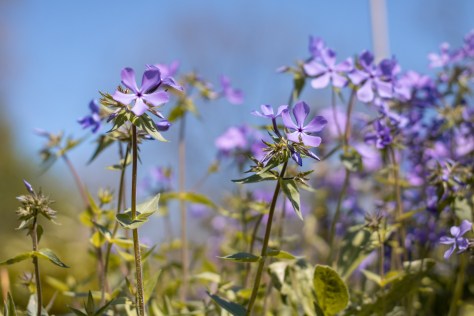
To both volunteers and those visiting the Phelps Grove park, the garden has been an encouragement. “It’s going to be beautiful, absolutely beautiful. I’m thrilled,” Pat Monday, a volunteer said. “I don’t plant a lot of natives [at home], but this has inspired me to plant natives.”
What keeps the group going, though, is not just the transformation of the space but the impact it could have beyond the park. “There’s so much that’s outside of my control, but we can control this,” Trippe said. “When there’s so much negative, this is something you can do that’s positive and that can work toward life surviving on this planet.”
Ryan agreed. “We can’t control anything, really, but we can make an impact in our own little community when it comes to caring for the earth.”
 Evangel Reporting & Storytelling